813 Satellite
The Arab Satellite 813 represents the first Arab space project led by the United Arab Emirates, enabling Arab scientists and researchers to actively participate in the development and use of space technologies. It was announced by His Highness Sheikh Mohammed bin Rashid Al Maktoum, Vice President and Prime Minister of the UAE and Ruler of Dubai, as a pioneering step toward building joint scientific and knowledge-based cooperation among Arab countries in the field of space.
The Arab Satellite 813 is also the first satellite in the UAE equipped with hyperspectral imaging technology, containing 205 spectral bands that provide advanced capabilities for high-precision data analysis and detailed observation of the Earth’s surface.
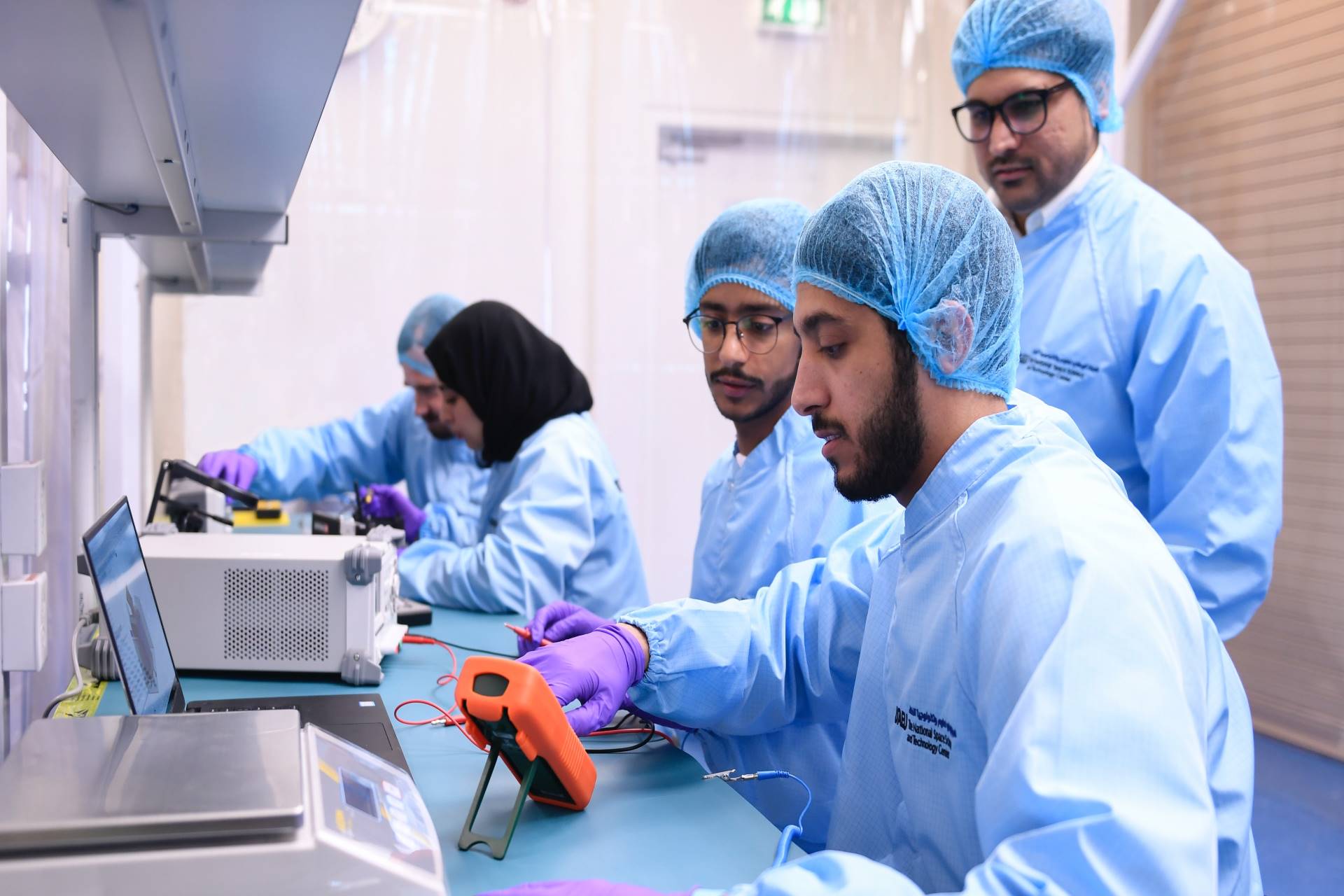
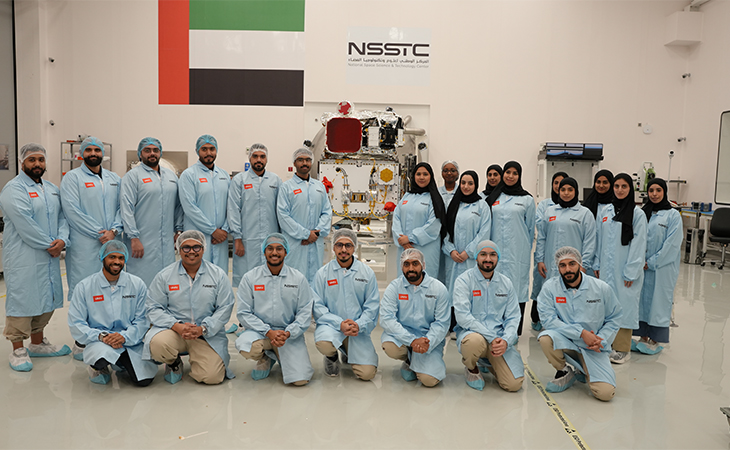
This project has been awarded to the National Space Science and Technology Center (NSSTC) at the United Arab Emirates University (UAEU).
In March 2019, His Highness Sheikh Mohammed bin Rashid Al Maktoum witnessed the signing of a charter to establish the first Arab group for space cooperation, comprising 11 Arab countries. Its first project will be the Arab Satellite 813, which will be developed by Arab scientists from the United Arab Emirates.
The name 813 refers to the year that marked the beginning of a flourishing scientific era at the House of Wisdom in Baghdad, a well-recognized center for knowledge exchange, and scientific advancement. The mission carries this legacy forward by bringing together Arab expertise to drive innovation in space science and applications.
Mission Objectives
Payloads Overview
- Hyperspectral Imager (HSI):
Operating across the visible and shortwave infrared spectrum (400-1700 nm), the HSI captures highly detailed spectral data with over 200 distinct bands. It enables precise monitoring of vegetation, water bodies, and land use for advanced environmental analysis.
- Panchromatic Imager (PAN):
This high-resolution sensor captures black-and-white imagery, providing fine spatial detail of Earth's surface. It is ideal for applications requiring sharp visual clarity, such as detailed mapping and surface feature detection.
- Atmospheric Polarimeter (AP):
The AP measures light polarization across 12 spectral bands, offering valuable data on atmospheric conditions. This enhances the accuracy of environmental monitoring and supports climate research.
Technical Specifications of the Arab Satellite 813
- Scientific Payloads
- Satellite Mass
- Hyperspectral Imaging (HSI) Spatial Resolution
- Panchromatic (PAN) Spatial Resolution
- Spectral Bands
- Spectral Range
- Spectral Sampling
- Signal-to-Noise Ratio (SNR) (Average); delivering high-quality, reliable data
- Swath Width
- Operational Period (Planned)
- Orbit Altitude (Orbit Type)
A hyperspectral earth-observing mission

Applications
- Marine Pollution
- Vegetation Health & Biomass
- Vegetation Health & Biomass
- Inland Waters & Coastal Monitoring
- Algal Blooms Mapping
- Soil Characterization & Land Degradation
- Land Use Land cover mapping
- Class: Micro Satellite - Class, 260 Kg
- Orbit: Low Earth Orbit (LEO) – SSO
- Launch date: Q4 of 2025
Funding and Support
Funded by the UAE Space Agency (UAESA), Telecommunications and Digital Government Regulatory Authority (TDRA) and the Information & Communication Technology Fund (ICT FUND) executed at The National Space Science and Technology Center (NSSTC) with the full support of The United Arab Emirates University (UAEU).